|
Dive the Largest Living Reef of any Caribbean Island
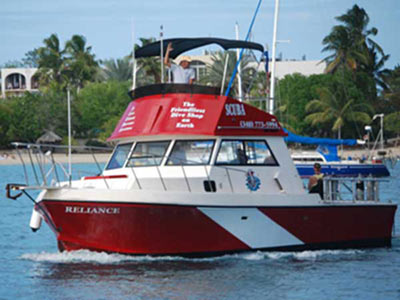
St. Croix boasts the largest living reef of any Caribbean island as it is almost completely surrounded by a barrier reef. Most diving on St. Croix is done along the north and west shores. The Island Conservation Effort (ICE) is a non-profit organization that maintains 52 moored dive sites along those shores. This reduces the need for dive boats to anchor and risk damaging the reef. Careful dive operators can take their divers to hundreds of dive sites in addition to the moored ones. With our dive boat, most sites are within 20 minutes from our dock. A spectacular wall runs along the entire north shore. In most places the wall begins at about 30'-40' and drops off to 13,200 feet! (Into deep diving?) Davis Bay (just off the Westin Carambola Beach Resort), Northstar, and Cane Bay are at the western end of the north shore diving and can boast the steepest wall in the world. In places it's like looking down an elevator shaft. There's plenty of coral and sponge life down the wall and a lot of marine life all along the top. Another couple of miles east is Salt River, the only site in America where Columbus actually landed, which he and his crew did in 1493. Salt River (it's actually more of a bay) was home to NOAA's Hydrolab for quite a few years. Both the East and West walls are spectacular dives that are frequented by both dolphins and sharks and border a canyon that's 300' deep. The west wall sites (Columbus Bluff and Grouper Grotto) have superb topography with a series of mini canyons you can swim through while the east wall's sites (Russ' Rock and Barracuda Bank) have an incredible amount of marine life, sponges, coral, and gorgonia. Between the sites that I have mentioned so far and the town of Christiansted the walls are more gradual and shallow so they make for good second dives. This area is along Long Reef and there's a lot of good sites regularly dived in that stretch. It's not unusual to see rays (including Spotted Eagle and Mantas), turtles, and of course a couple of zillion colorful tropical fish. These reefs are ALIVE! There are five wrecks located off the west shore of the island. Now these aren't Spanish galleons or anything like that. There's a large container ship, two tug boats (you might have seen one in the movie Dreams of Gold the Mel Fisher Story), an oil barge and a small cargo ship that have all been sunk for dive sites. The container ship Rosa Maria was hauling cinder blocks to St. Croix but they off loaded one side first which flipped the ship over and sank it. It was towed to this site and dynamited to sink it. Only half of the dynamite went off which flipped it back to right side up before sinking. Don't worry the rest of the dynamite was removed. The bow of this ship is in about 70' and the propeller touches the sand at 110'. Adjacent to is is the newest wreck, the tugboat Coakley Bay. Just south of these wrecks are the other three wrecks which are in shallow enough water to make a good second dive. South of that point there are many almost virgin coral reefs in only about 30' of water. They stretch along the entire west end of the island. Finally the west shore was host to the Frederiksted pier which has been called one of the world's best macro dives. The pier was heavily damaged in Hurricane Hugo back in 1989. The resulting building of the new pier which was just opened in July of 1994 sadly meant that the old pier had to be destroyed. The pillars of the pier which hosted more sponge and coral life than you could imagine were barged to a site in Butler Bay which is located next to the wrecks mentioned above. While a lot of the life unfortunately didn't survive the trip, it has still made the beginnings of a great artificial reef. The new pier already has a lot of life on it, and some of the outer pilings from the old pier (their called dolphins) are still there and have incredible life on them. It's not unusual to see seahorses, frogfish, lobster, and a lot of eels there, especially on night dives. The diving around St. Croix is some of the best in the Caribbean, it's just underrated as the government doesn't spend much money promoting it so nobody knows much about it. Come to America's Paradise and let a top rated dive staff take you on the dives of a lifetime.
|
|